

SHERIFF

INFORMATION
In an era of wide-open frontier lands and dusty trails, a local lawman and his posse were the best people in any given county had to keep them safe and sound. Sheriffs are something of an icon of the 1800s, combating the lawlessness and savagery of the era with cold steel and quick horses. Each county in Lavinia has a sheriff - and by extension, his office.
Only five sheriffs may exist at a single time, one for each county of the state of Lavinia - as such an important and wide-reaching role, it is expected that the player of the U.S.M. is an active member of the community.
REQUIREMENTS
Sheriffs are considered a semi-restricted. Characters may be of any racial heritage to apply, but must be male in respect to historical accuracy.
BENFITS
-
Base Paycheck of $12.00
-
Access to player bounties
-
Access to NPC bounties
-
Right to enforce county laws
GUIDELINES
Only one Sheriff may exist per county at one time - and may in turn hire up to six deputies to help them manage the region. Undersheriffs and deputies will be offered the role of sheriff before applications open. Sheriffs have the right to respond to crimes within their own county, or that they are a witness to.
A certain degree of realism and proper portrayal is expected in the roleplay of a sheriff - a detailed guide of integrating realism into your roleplay is listed below.
Corruption will not be allowed for this career.
ROLEPLAYING A SHERIFF
The history of the office of sheriff dates back to England in the Middle Ages. In England, the sheriff came into existence around the 9th century. This makes the sheriff the oldest continuing, non-military, law enforcement entity in history. The first elected sheriff in the United States was William Waters in 1652 in Northampton County in the colony of Virginia. The office of the sheriff is set apart from other law enforcement agencies due to its direct accountability to citizens through the election of the Sheriff.
By the 1880s the office of the sheriff was the most important arm of law enforcement, in counties that often didn’t have the population for city departments, they kept law and order for the every-day citizen.
Sheriffs and their deputies were expected to keep up with the following duties:
-
Apprehending fugitives in their jurisdiction on county charges
-
Serving papers within their county from district courts
-
Maintaining jails within their jurisdiction
-
Keeping the peace within their jurisdiction
-
Assisting federal forces when requested.
The Sheriff was the highest representative of law in their county and though accountable to the citizenry, sheriffs at the time held immense amounts of power. They were assisted by several sworn deputies in those duties.
The role of sheriff is a nuanced one. He needs to be strong enough to keep order, but likeable enough to keep office. The person playing the role will need to take it seriously to prevent revocation.

JURISDICTION
A sheriff’s jurisdiction, and that of his deputies, would be within the county that he is elected or hired into. In that particular county, and in matters that are not federal, he would have the authority to intervene in that situation. The state of Lavinia has five such ‘counties’, West Elizabeth, New Hanover, Lemoyne, Ambarino, and New Austin.
The sheriff’s authority ends at the county line with the exception of a few scenarios; if he has been deputized by a US Marshal, if he has been requested to assist by the sheriff of the county he is entering, or if he is in fresh pursuit. Fresh pursuit is only in an instance where a lawman sees the crime committed, he begins the pursuit in his jurisdiction, and it is continuous with no breaks. An arrest made in fresh pursuit should be reported as soon as possible to the sheriff of the jurisdiction where the arrest took place.
DUTIES & RESPONSIBILITIES
1. Enforcement of the law
-
Enforce state laws and county ordinances across the county.
-
Arrest persons accused or suspected of crimes.
-
Suppress riots, disturbances, and unlawful assemblies.
-
Conduct investigations into theft, assault, murder, cattle-rustling, stage and train robberies, and other felonies.
-
Pursue fugitives in fresh pursuit, even across county lines when necessary.
-
Appoint and supervise deputies to aid in maintaining law and order.
2. Court and Judicial Functions
-
Serve writs, summonses, warrants, and subpoenas issued by county and state courts.
-
Provide security for the courthouse and maintain order during trials.
-
Escort prisoners to and from court proceedings.
-
Manage jury selection and ensure the attendance of jurors.
3. Execute court orders, including evictions, foreclosures, and property seizures.
-
Custodial Responsibilities.
-
Operate and oversee the county jail.
-
Guard and provide for prisoners in custody.
-
Transport convicted persons to penitentiaries or executions within the county.
-
Carry out sentences handed down by the county courts, including corporal and capital punishment .
4. Community and Political Role
-
Act as the chief law officer and symbol of authority for the county.
-
Answer directly to the voters of the county (as sheriffs were generally elected).
-
Mediate disputes between citizens when possible, before they escalated into violence or litigation.
-
Uphold the peace in rural areas beyond the reach of town marshals and city police.
-
Provide posse comitatus (raising a posse of armed citizens) when extra manpower was needed to apprehend criminals or quell uprisings.

RANKING & APPOINTMENT
The sheriff was the chief law officer of the county, almost always chosen by popular election. He would hold wide discretion in enforcement of the law, appointing deputies, and administering justice within the county. Because the sheriff answered directly to the people, the position was powerful and very political. The average terms in office varied by state, but typically ran two to four years.
Deputies at the time were appointed by the sheriff, not elected and generally had the same powers as the sheriff while acting under his authority. They served at the pleasure of the sheriff, but could be dismissed at any time and their jobs ended when the sheriff’s commission expired. Some were full-time and salaried by the county, while others were appointed temporarily for specific tasks.
Sheriff’s offices at the time were a flat power structure, the sheriff being at the top. His handful of deputies would be below him, and any other staff, such as jail personnel and clerks would be below them.
PRESENTATION & ATTIRE
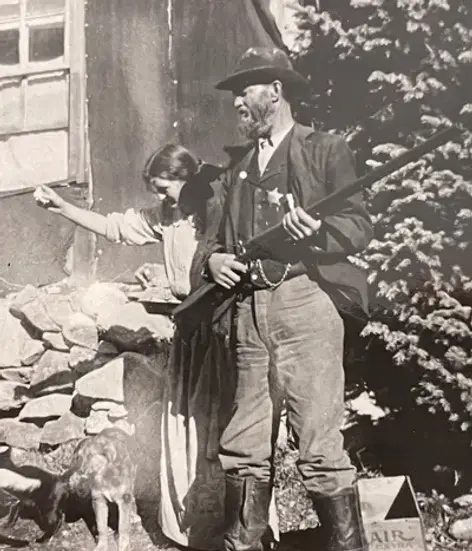
The sheriff, being the highest law officer of the county, was expected to maintain a dignified and respectable appearance, befitting the authority of his office. While frontier conditions often demanded practicality over finery, the manner in which a sheriff presented himself carried weight with both townsfolk and outlaws.
Clothing:
-
Shirt - white or light colored shirts with detachable collars for easier laundering, calico or striped shirts for harder work.
-
Trousers - Wool trousers in dark colors for court appearances, cotton duck or denim trousers for day to day work.
-
Waistcoat - Generally dark wool, could be plain or patterned.
-
Coat - Frock coats, generally dark wool, for court appearances and funerals, sack coats were common for everyday wear, duster coats for bad weather.
-
Boot - Cowhide or calvary riding boots were common.
-
Hat - Broad-brimmed felt hats, bowlers and derby hats, and early Stetson were common.
Gear:
-
Sidearm: The sidearm would be a revolver, commonly a Colt or a Smith and Wesson type firearm in a large enough caliber to be effective quickly, generally a .45 caliber.
-
Rifle: A repeater or a shotgun was a common choice for pursuits or situations where more firepower than a revolver would be appropriate.
-
Badge: The badge was generally nickel, silver, or brass and could be in the shape of a star or a shield, but was worn to show the lawful authority of the individual in the county.
-
Miscellaneous: manacles or a leather thong would be carried to secure prisoners, a notebook and pencil for notes, a pocket watch, keys for the jail, these would be carried with the sheriff.
Grooming and Demeanor:
-
The sheriff being an elected official he would have to comport himself professional, part politician, part enforcer of the law he would see that he is always well dressed and groomed when interacting with the general public.
-
Beards and mustaches were common.
-
Out on the trail, or in pursuit of criminals, more sturdy clothing could be worn.
-
The Sheriff shall comport himself with sobriety, firmness, and impartiality. He must refrain from intemperance, vulgar speech, and all habits that would diminish respect for his station.
ETHICS & MORALS
In practice the moral and ethics of the sheriff’s office was determined by the moral and ethics of the men who ran them. Many were good and decent servants of the people, but as with any position of power, there were those who sought power and influence for themselves.
Some sheriffs used the office to enrich themselves, play favorites in prosecution, and even protect themselves from the long arm of the law. The allure of power and influence drew men with a variety of motivations.
In Lavinia we ask that our sheriffs not be corrupt to ensure the equal and impartial enforcement of the law. The sheriff may of course have personal prejudice, but we do ask that they remain as fair and impartial as possible.